

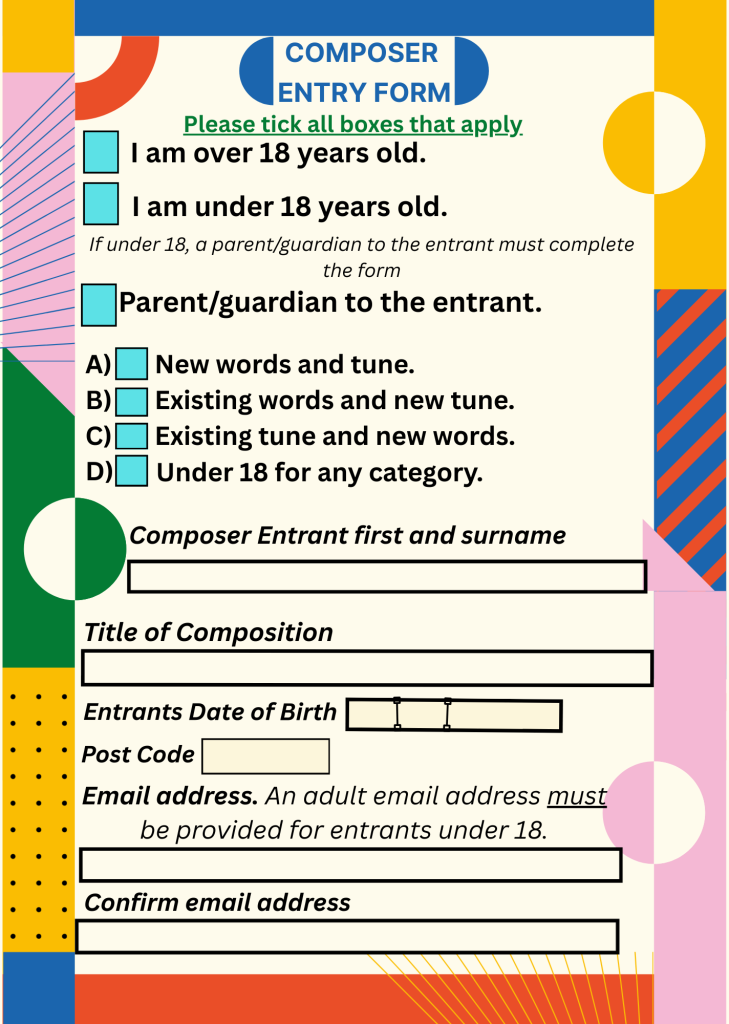
Click to download the application form here
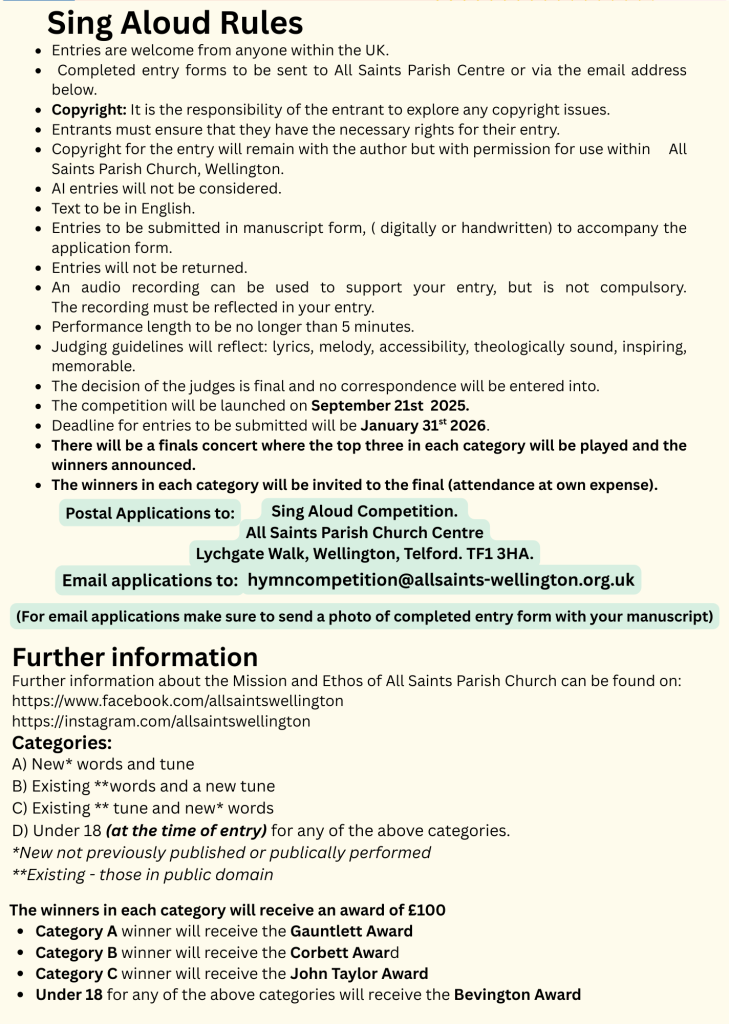
Sing Aloud Rules
- Entries are welcome from anyone within the UK.
- Completed entry forms to be sent to All Saints Parish Centre or via the email address below.
- Copyright: It is the responsibility of the entrant to explore any copyright issues.
- Entrants must ensure that they have the necessary rights for their entry.
- Copyright for the entry will remain with the author but with permission for use within All Saints Parish Church, Wellington.
- AI entries will not be considered.
- Text to be in English.
- Entries to be submitted in manuscript form, ( digitally or handwritten) to accompany the application form.
- Entries will not be returned.
- An audio recording can be used to support your entry, but is not compulsory.
- The recording must be reflected in your entry.
- Performance length to be no longer than 5 minutes.
- Judging guidelines will reflect: lyrics, melody, accessibility, theologically sound, inspiring, memorable.
- The decision of the judges is final and no correspondence will be entered into.
- The competition will be launched on September 21st 2025.
- Deadline for entries to be submitted will be January 31 2026.
- There will be a finals concert where the top three in each category will be played and the winners announced.
- The winners in each category will be invited to the final (attendance at own expense).
Postal Applications to:
Sing Aloud Competition.
All Saints Parish Church Centre
Lychgate Walk, Wellington, Telford. TF1 3HA.
Email applications to: hymncompetition@allsaints-wellington.org.uk
Download the application form here
(For all applications, please make sure to send a completed entry form with your manuscript)
Further information
Further information about the Mission and Ethos of All Saints Parish Church can be found on: https://www.facebook.com/allsaintswellington
https://instagram.com/allsaintswellington
Categories:
A) New* words and tune
B) Existing **words and a new tune
C) Existing ** tune and new* words
D) Under 18 (at the time of entry) for any of the above categories.
*New not previously published or publically performed
**Existing – those in public domain
The winners in each category will receive an award of £100
Category A winner will receive the Gauntlett Award
Category B winner will receive the Corbett Award
Category C winner will receive the John Taylor Award
Under 18 for any of the above categories will receive the Bevington Award
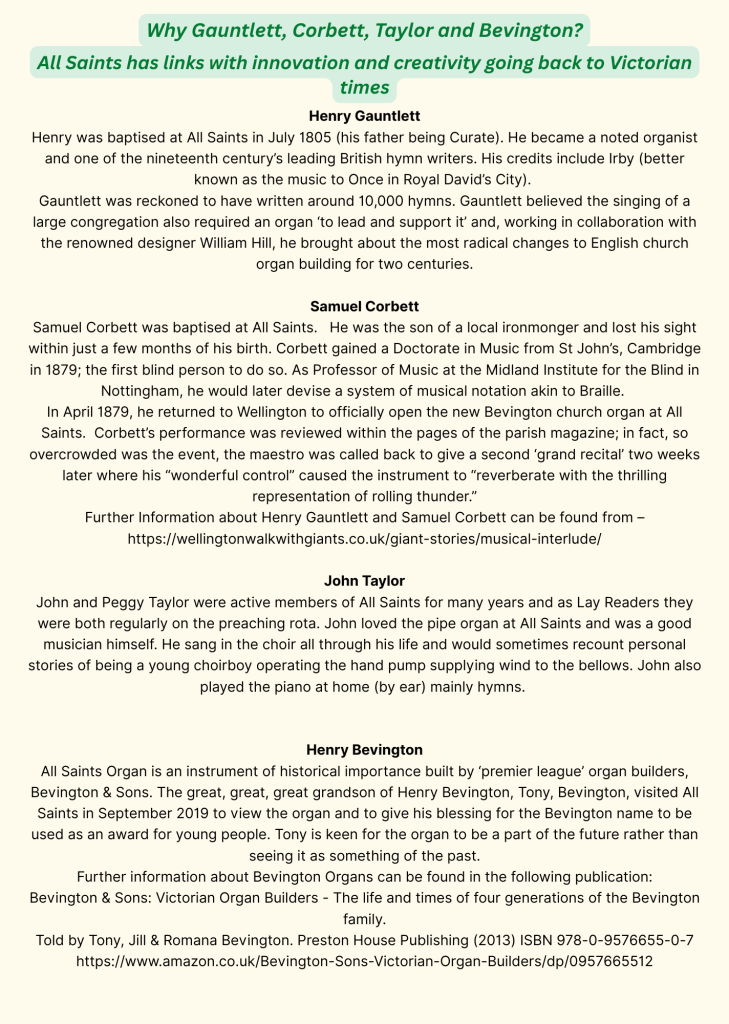
Why name the Awards – Gauntlett, Corbett, Taylor and Bevington?
All Saints has links with innovation and creativity going back to Victorian times –
Henry Gauntlett
Henry was baptised at All Saints in July 1805 (his father being Curate). He became a noted organist and one of the nineteenth century’s leading British hymn writers. His credits include Irby (better known as the music to Once in Royal David’s City).
Gauntlett was reckoned to have written around 10,000 hymns. Gauntlett believed the singing of a large congregation also required an organ ‘to lead and support it’ and, working in collaboration with the renowned designer William Hill, he brought about the most radical changes to English church organ building for two centuries.
Samuel Corbett
Samuel Corbett was baptised at All Saints in … He was the son of a local ironmonger and lost his sight within just a few months of his birth. Corbett gained a Doctorate in Music from St John’s, Cambridge in 1879; the first blind person to do so. As Professor of Music at the Midland Institute for the Blind in Nottingham, he would later devise a system of musical notation akin to Braille.
In April 1879, he returned to Wellington to officially open the new Bevington church organ at All Saints. Corbett’s performance was reviewed within the pages of the parish magazine; in fact, so overcrowded was the event, the maestro was called back to give a second ‘grand recital’ two weeks later where his “wonderful control” caused the instrument to “reverberate with the thrilling representation of rolling thunder.”
Further Information about Henry Gauntlett and Samuel Corbett can be found from –
John Taylor
John and Peggy Taylor were active members of All Saints for many years and as Lay Readers they were both regularly on the preaching rota. John Loved the pipe organ at All Saints and was a good musician himself. He sang in the choir all through his life and would sometimes recount personal stories of being a young choirboy operating the hand pump supplying wind to the bellows. John also played the piano at home (by ear) mainly hymns.
Henry Bevington
All Saints Organ is an instrument of historical importance; one of only a few outside London built by ‘premier league’ organ builders, Bevington. The great, great, great grandson of Henry Bevington, Tony, Bevington, visited All Saints in September 2019 to view the organ and to give his blessing for the Bevington name to be used as an award for young people. Tony is keen for the organ to be a part of the future rather than seeing it as something of the past.
Further information about Bevington Organs can be found from the following publication,
Bevington & Sons: Victorian Organ Builders – The life and times of four generations of the Bevington family.
Told by Tony, Jill & Romana Bevington. Preston House Publishing (2013) ISBN 978-0-9576655-0-7